A content creation workflow should move an expert’s knowledge from an idea to a published article. The argument, voice, and timing should survive the trip. Most teams struggle because drafting is only one part of that job.
Research and subject knowledge may sit with one group. Approvals, visuals, search engine optimization, and publishing may sit with others. A finished draft can wait days or weeks for the next person in line. I built the Content Engine to keep those jobs connected while leaving the important decisions with the human author.
In my own work, topic selection, outline review, drafting, and editing can take one to two hours when the source material is ready. Saved context, dictation, automated checks, and fewer handoffs make that possible.
Three ways to run a content creation workflow
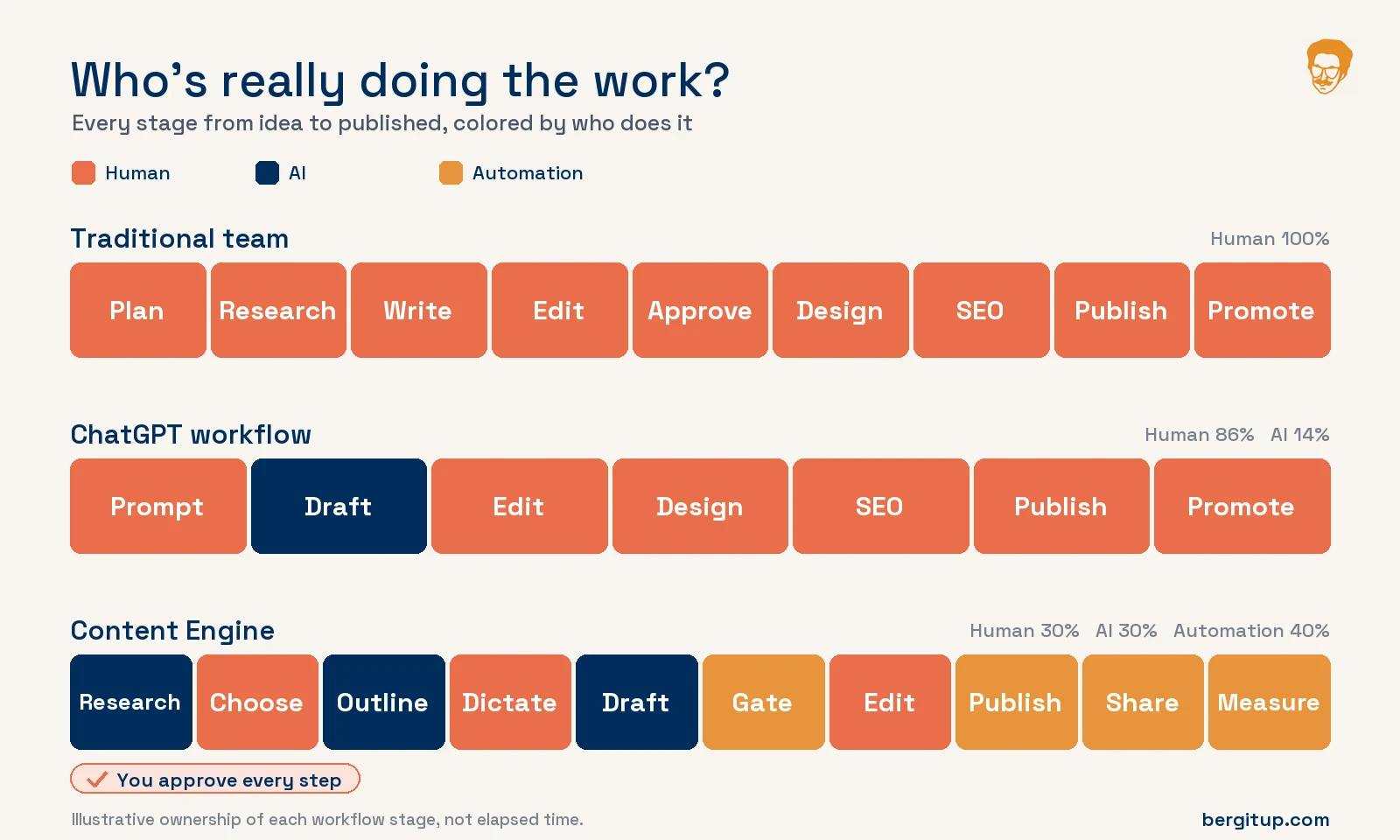
Teams usually follow one of three models: traditional production across several roles, a short ChatGPT workflow, or a Content Engine that combines AI assistance with human judgment. The difference is bigger than writing speed.
Traditional production spreads context across the team
A traditional process may involve a strategist, in-house expert, search specialist, writer, editor, designer, and website manager. Small firms build the same chain from employees, freelancers, and an agency.
Each handoff creates another place for context to disappear. A writer may aim at a different buyer than the strategist. An editor may remove the language that made the idea specific. A finished article may sit while the design team works through its queue.
Corrections travel backward through the same chain. If a source changes a claim after the graphic is finished, the writer, designer, search specialist, and website manager may all need another pass. The publishing window can close while everyone waits.
A ChatGPT workflow shortens the blank-page stage
The common AI workflow is prompt, draft, edit, copy, and publish. It can produce words quickly, but the model starts with little durable knowledge of the business.
The prompt has to carry the product, buyer, positioning, evidence, voice, and purpose of the article. Missing context gets replaced with generic copy. That is why articles from different companies can sound like they came from the same source.
Google’s guidance on generative AI content draws the same line. Google says generative AI can help with research and structure. Publishing many pages without adding value may violate its scaled content abuse policy.
The Content Engine works like pair writing
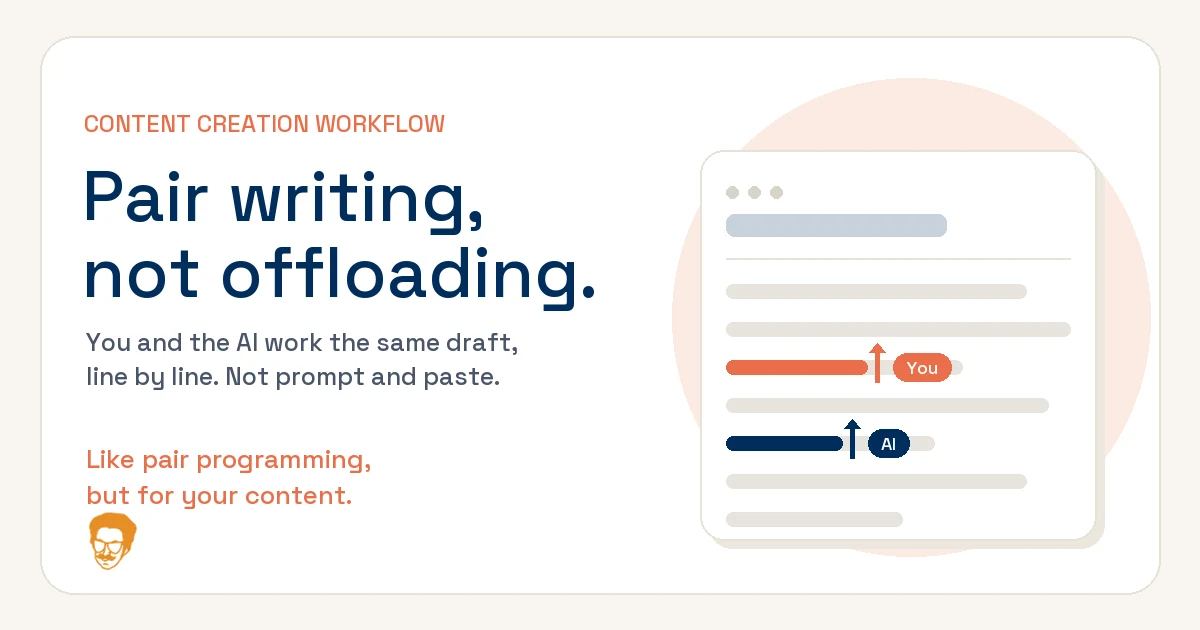
The Content Engine keeps the speed of AI while giving the author several points to steer the work. I describe the method as pair writing because the author and agent keep passing the work back and forth.
The engine already carries the business context and production rules for the firm. It can surface a keyword opportunity and propose an outline. The human chooses the topic, changes the outline, supplies the argument, and approves the final article.
That distinction matters. The engine helps decide what could work. The person responsible for the business decides what should be said.
The human drives every consequential decision
Automation can organize information and catch errors. It cannot decide which business problem deserves attention this week. It also cannot decide whether a claim fairly represents the work.
The author remains responsible for:
- choosing the topic and publication timing
- approving or rebuilding the outline
- supplying firsthand evidence and source material
- deciding how strongly the evidence supports a claim
- correcting the voice and emphasis
- approving the visuals
- giving final publication approval
The roadmap guides the choice without taking it over. Search volume, competition, and buyer intent can move a topic higher, but a live customer question or market change may make another article more useful now.
Dictation turns expertise into source material
Dictation is one of the fastest ways to get real expertise into the system. I can talk through the work, react to a proposed direction, and add the detail that would never appear in a generic prompt.
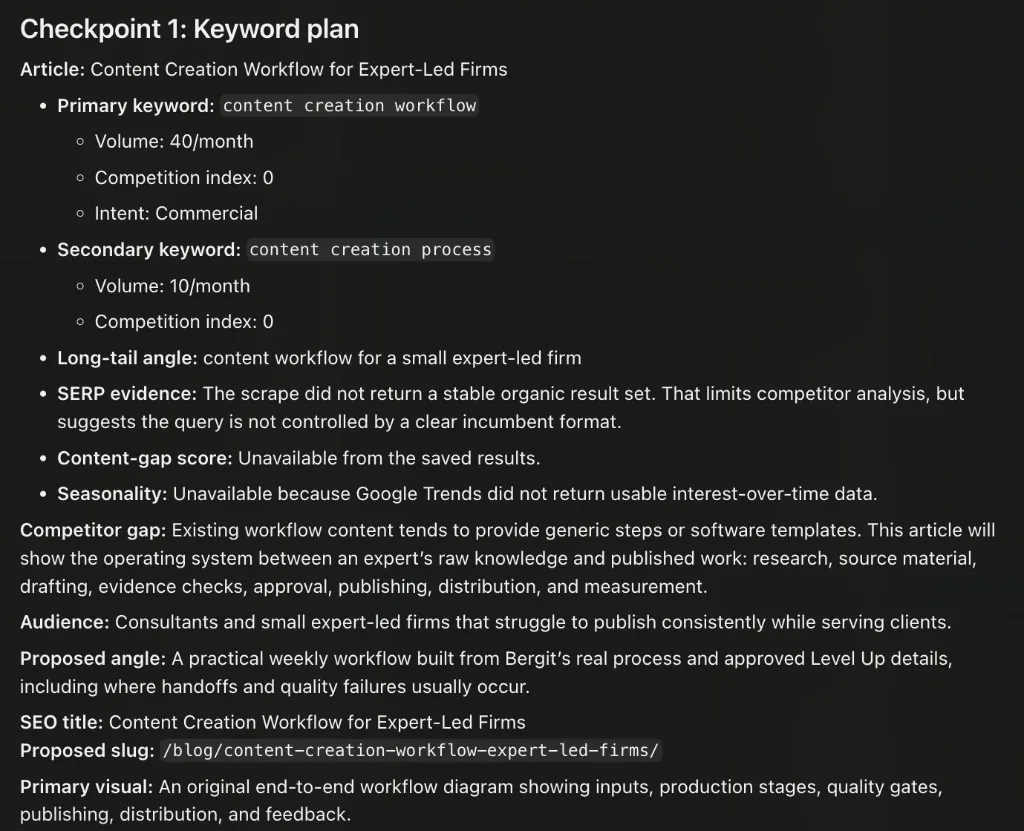
This article followed that process. The engine surfaced a research-backed topic, then I talked through the manual production problems, the role of human review, the use of voice, and the three workflow models. The agent organized that material into an outline that I changed before drafting began.
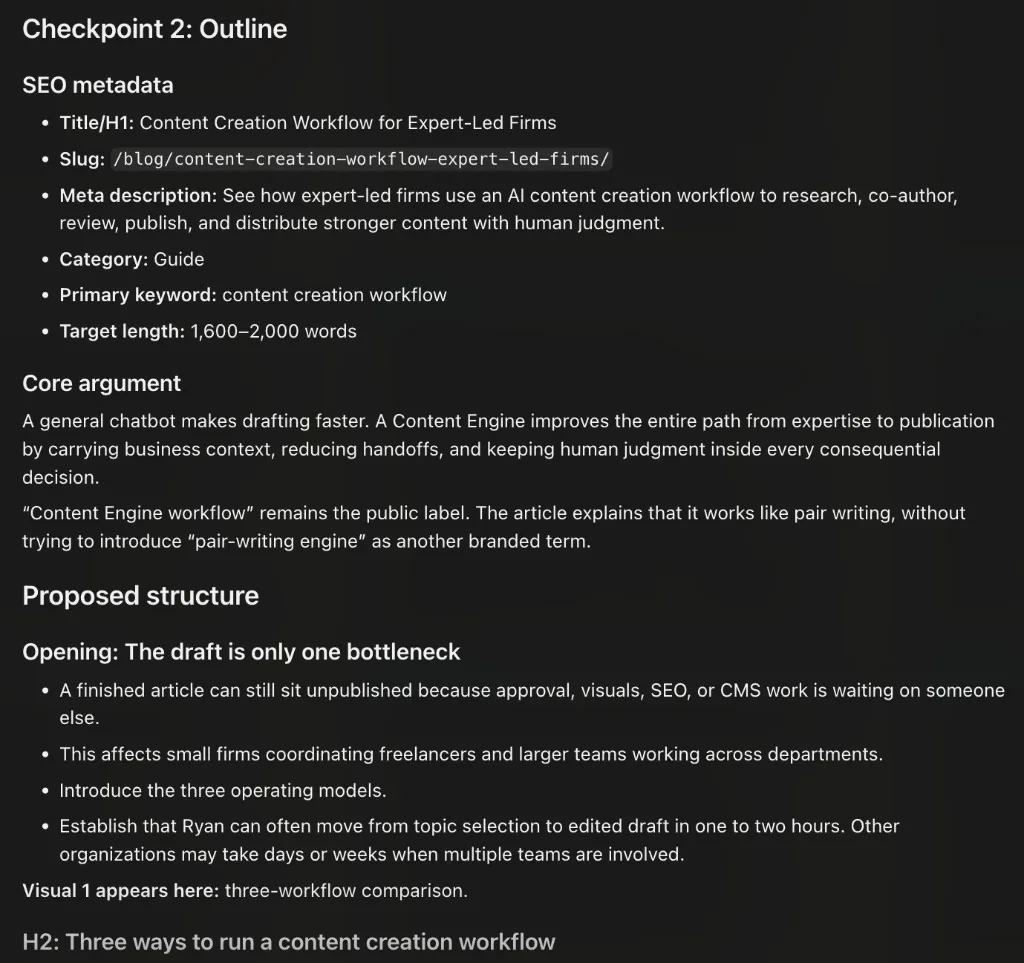
Voice input does not remove authorship. It gives the agent better material to shape. I can correct an assumption while it is still an outline instead of discovering the problem after a polished draft reaches me.
I used the same principle when I built an AI content engine for Level Up Product. Jon Shutt could talk through a story in a few minutes, then revise the resulting post by voice or keyboard. His positioning, stories, and language stayed inside the engine instead of being rebuilt for every post.
Persistent context keeps article fifty connected to article one
A useful content creation workflow needs more than a prompt library. It needs a maintained source of truth for the business and the rules that govern production.
My engine can carry:
- products, services, and buyer definitions
- positioning and the market wedge
- voice rules and writing patterns to avoid
- the active content roadmap
- previous keyword and search results page research
- approved client proof and claim boundaries
- internal-link destinations
- metadata, image, and publishing requirements
That context changes the review. The author spends less time repeating basic instructions and more time improving the argument. New articles can also link back to the right offer, proof, and supporting pages without rebuilding the site map from memory.
Internal links help search engines discover pages and understand how the site’s ideas fit together. Google also lists findable internal links among its best practices for appearing in AI search features. Maintaining that structure by hand takes time. A changed URL or fact may require updates across several articles.
New content creates another maintenance job. Older articles may need links to the new page. Stale references and renamed offers may also need updates across the library. The engine can find the affected passages, propose new links or facts, and apply approved changes without a manual pass through every article.
Clients can also bring their own datasets and source material. Call transcripts, product documents, customer research, spreadsheets, screenshots, and internal reports can shape the roadmap and give each article evidence that a general model cannot supply.
The quality gate blocks preventable problems
The quality gate runs before I present a draft for approval. It checks the writing, evidence, search basics, links, and production requirements, then sends failed work back for revision.
For Bergit articles, the gate checks for banned language, robotic sentence patterns, unsupported claims, missing keyword placements, incomplete metadata, broken links, and image errors. A draft that fails stays inside the production loop.
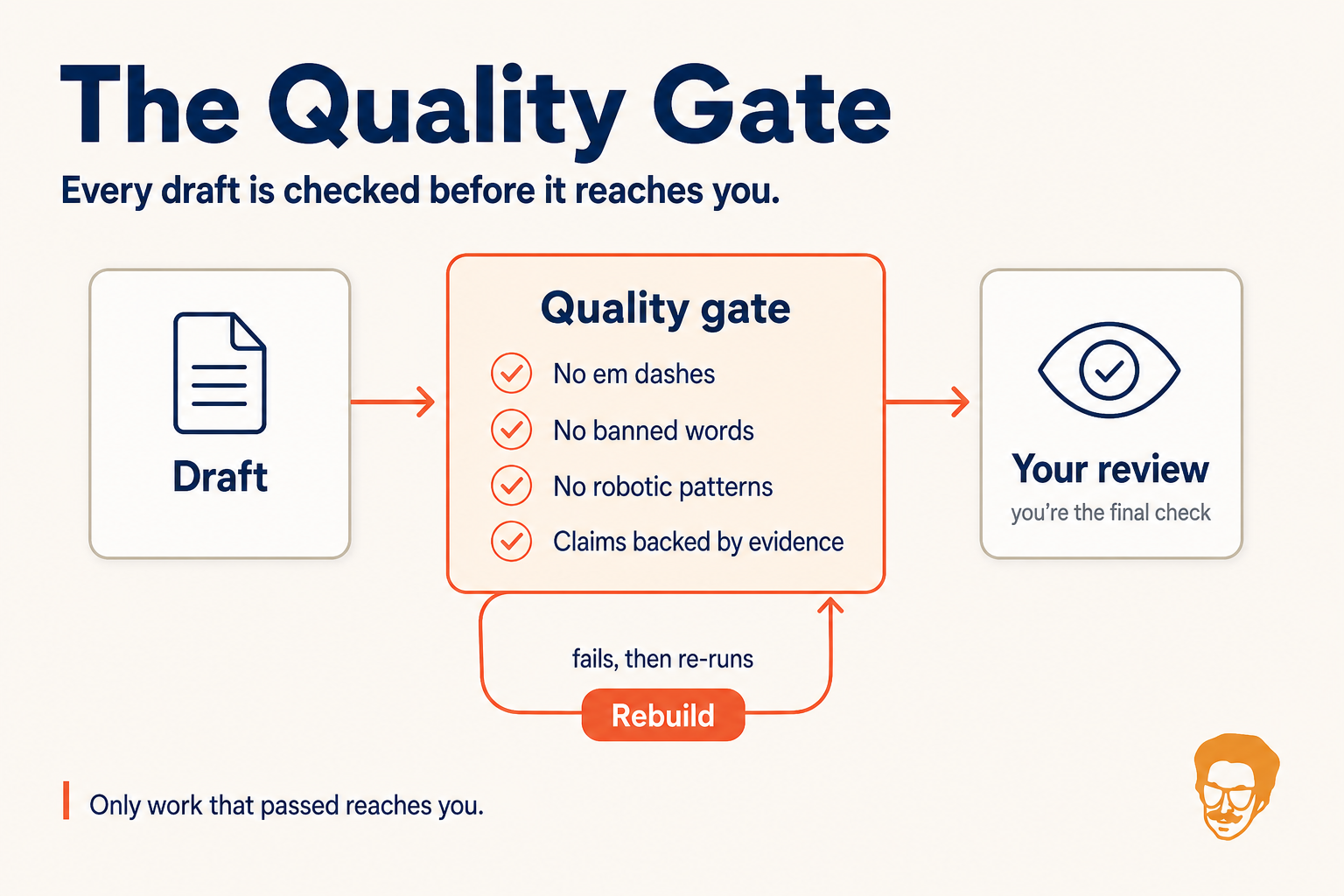
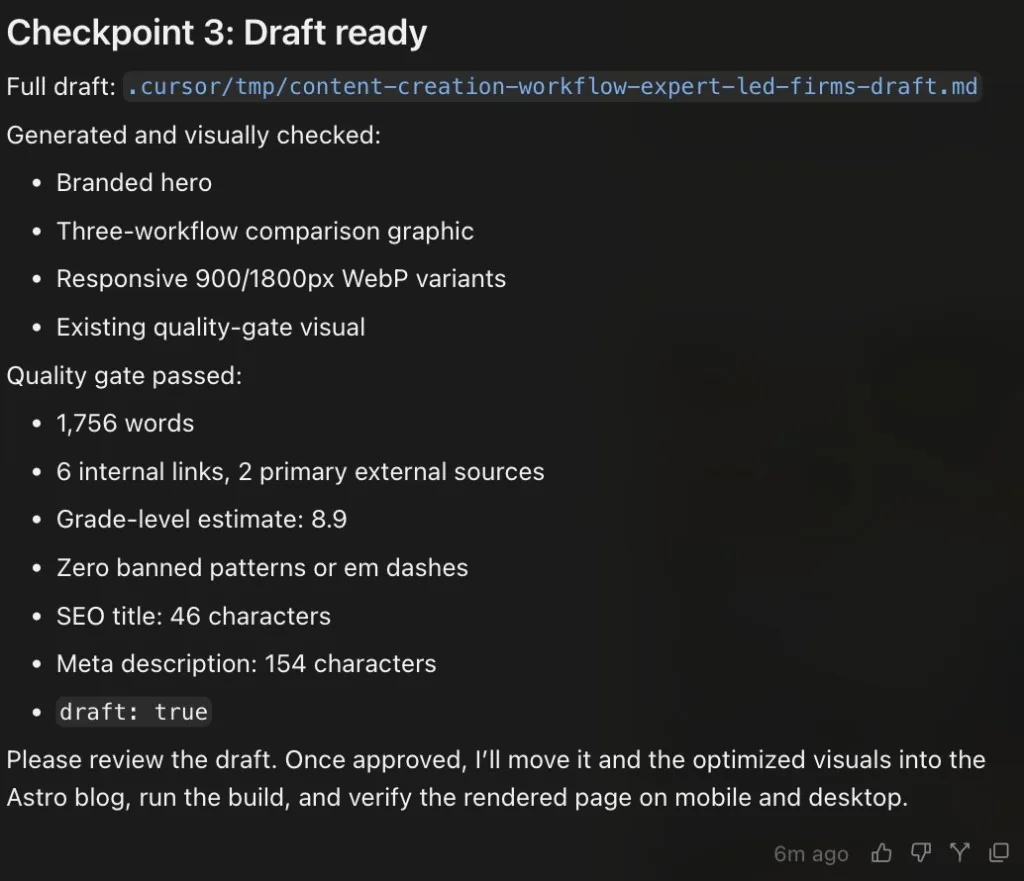
The gate cannot determine whether an argument is worth making. It cannot supply lived experience that the author never shared. Strategy, taste, truth, and final approval remain human jobs.
Publishing belongs inside the production system
A document in Google Docs has not completed the content creation process. Images, metadata, structured data, internal links, and the article body still have to reach the website correctly.
WordPress may require image uploads, alt text, SEO plugin fields, categories, structured data, and repeated preview checks. An Astro site may require frontmatter, image files, and schema. It also needs a clean build and deployment through a repository. Both routes demand specific knowledge.
The engine can plug into a wide range of systems. Two recent examples are WordPress through its API and Astro deployed through Netlify, which is how this site runs. SEO research and writing, custom visuals, CMS automation, and Buffer distribution can be added as modules when they fit the client’s production needs.
Those connections preserve context through the final step. Image descriptions can reflect what the visual actually shows. Structured data can match the visible article. The published page can carry the same title, description, links, and claims that passed review.
Speed comes from fewer resets
The one-to-two-hour production window I sometimes reach does not come from typing faster. The engine cuts repeated setup between stages.
The business context is already loaded. Dictation produces source material quickly. The quality gate catches predictable problems before review. Publishing automation removes the final sequence of copying, uploading, formatting, and checking.
Other organizations may need days or weeks for the same path because each role has competing priorities. That does not make the people slow. The workflow keeps asking them to stop, reload what they lost, complete one piece, and hand it to the next queue.
Faster publishing starts the search clock sooner
Search results still take time. Google says some improvements can appear within days. Its systems may need several months to confirm that a site is producing helpful, reliable content. Google also states that no change guarantees a visible ranking improvement.
That makes three to six months a reasonable planning window, not a promise. Publishing faster gives the work more time to be crawled, indexed, measured, and improved.
Juniper Real Estate moved sooner than that planning window. I shipped 23 pages in one week, then compared two equal 110-day periods in Google Search Console. Impressions grew roughly 20 times and clicks grew roughly four times. The full Juniper search case study shows the dates, charts, and method behind those numbers.
One client result cannot predict the next one. It does show what becomes possible when research, original material, production, and publishing move through one system.
Build the system before adding another hire
An expert-led firm can use a Content Engine in two ways. It can extend the current team, or it can become a licensed production system the firm runs before hiring another content person.
The second path gives a future hire something concrete to inherit. The positioning, voice rules, roadmap, quality checks, and publishing workflow already exist, so the system keeps its context as the team changes.
The model still requires participation from the expert. It is a poor fit for a team that wants cheap volume or has no source material to contribute. The Content Engine offer is designed for firms with real expertise and a few hours each month for review and approval.
Map the gaps before choosing another tool
You can diagnose your current workflow without buying software. Follow one recent article from idea to publication and answer eight questions:
- Where does the business context live?
- Who chooses the topic and timing?
- How does subject expertise enter the draft?
- Who can block or delay approval?
- Who owns visuals and search implementation?
- How does the finished article reach the website?
- What catches weak claims, voice problems, and technical errors?
- How is the published article distributed and measured?
Mark every place where the work waits, changes owners, or loses context. Those are the parts of the system worth fixing first.
Publication should also trigger distribution. The same approved article can feed a LinkedIn post, email, sales follow-up, or scheduled Buffer queue. Each format should fit its channel instead of copying the article word for word. Search performance, social responses, and sales conversations then feed the next roadmap decision.
If your content creation workflow depends on rebuilding the same context for every article, take a closer look at the engine I build. You can also read why I approach the work as a content-systems builder or book a fit call to map what your team needs.