
Start with Berg

$6,000two weeks

The cheapest, fastest way to work together. You get the diagnosis in writing and one of its fixes built inside two weeks, not a list you have to hire someone else to act on.

How the two weeks run

The first days go to reading the situation: the site, the numbers, the tools, and whatever your team is doing by hand. I come back with what I would fix first and why. We agree on one thing, I build it, and you get a short before-and-after so the change is visible rather than asserted.

What ships depends on where it is stuck

One shape, one price, four possible outputs. On the fit call I tell you which of these your situation calls for.

  • One finished story, with its search and schema groundwork included
  • One broken step in the lead flow, repaired and live
  • One automation running in production, plus the session that hands it over
  • A working script or clickable prototype built on your own data

No live site access required to start. A shared document or a staging link is enough.

Four places it usually points

These are not separate packages. They are what Start with Berg turns into, and the direction a bigger build would take from there.

Content and publishing

Nobody can find you.

Articles and pages built from your own material, a refresh of the pages you already have so they stop sliding, and the search and AI-answer research that decides what is worth writing next.

The bigger build in this lane is the Content Engine, a system your team runs instead of pages ordered one at a time.

Lead systems

Leads come in and go cold.

Capture and intake, enrichment so a lead arrives with context attached, scoring against the clients you actually want, routing to the right person, and the follow-up that closes the silence.

Bigger builds here look like a research system that finds and qualifies prospects on a schedule instead of waiting on a form.

Workflow and AI adoption

Your team is still doing it by hand.

Automations and digests that replace manual checking, internal tools your team runs itself, and honest training on where AI helps and where it quietly makes the work worse.

Teams that want to run AI themselves usually follow with a working setup and the review habits that keep the output trustworthy.

Software and tools

The tool you need was never built.

Internal tools, assistants that sit where your team already works, calculators and assessments your buyers use, and prototypes that answer a question before anyone commits to a full build.

If the prototype earns it, the full build follows as its own scoped project with its own timeline.

What happens after two weeks

Four honest options, and I will tell you which one I think you should take even when it is the first one.

  • Stop here. You keep what shipped and the read on the rest. Nothing your team fixes from that read has to be redone if you come back later.
  • Scope the bigger build. The two weeks usually makes the real project obvious. I quote it properly instead of guessing at it on a call.
  • Build a Content Engine. When the two weeks proves content is where the money is, this is the version that gets built and handed over.
  • Keep me running it. For teams that would rather not take the keys yet.

When the groundwork comes first

If you have published good work and watched it go nowhere, the cause is often underneath the page rather than in it: crawl and indexing errors, missing schema, or two of your own pages competing for the same search. None of that is visible from the outside, which is how firms end up paying for the same content twice. Usually the repair folds into the work already scoped. If it is big enough to fill the two weeks by itself, I will tell you before you pay anything and price it separately.

The Content Engine

3 to 4 week build

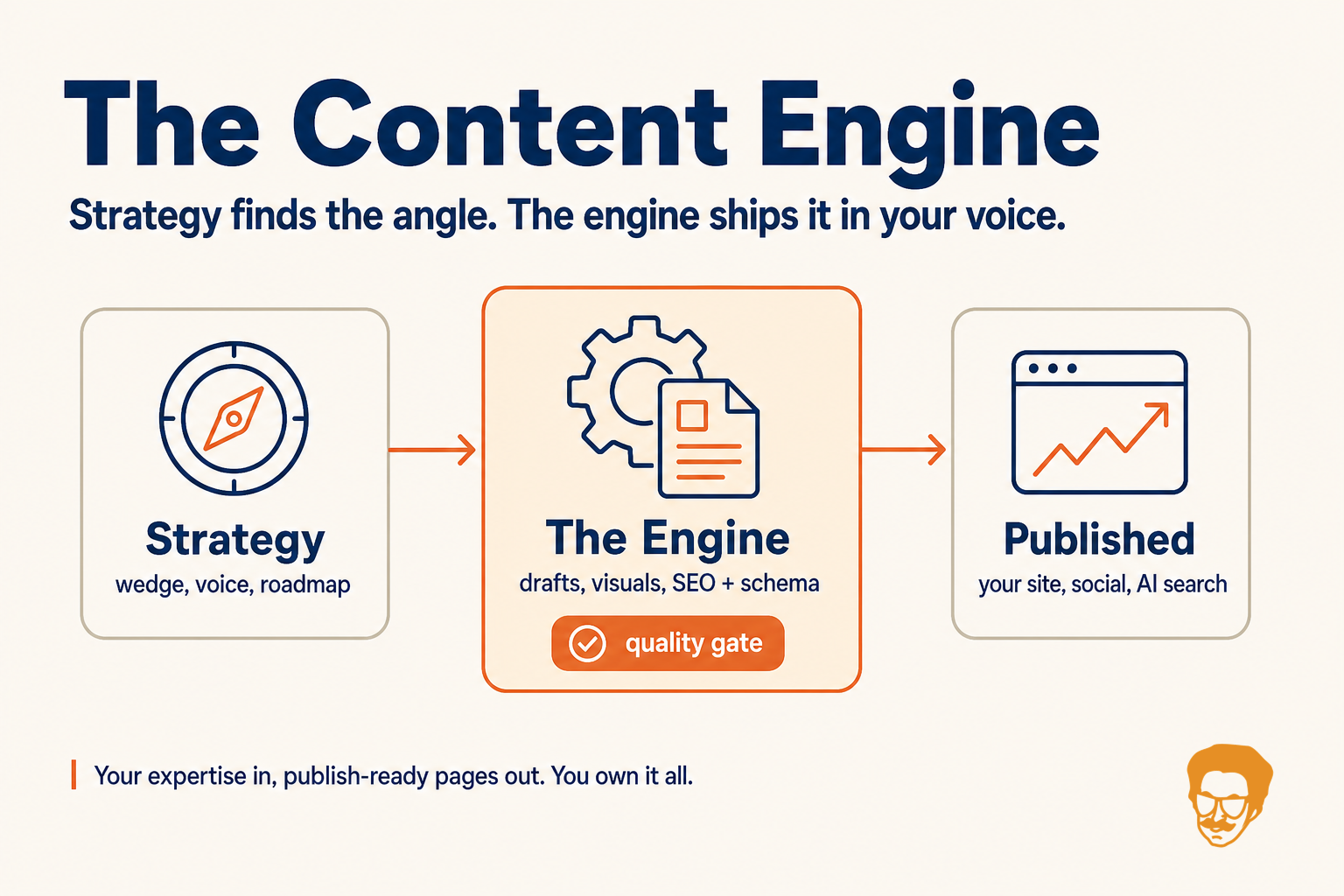
Two halves. The strategy, meaning the angle your market is missing and only you can own. Then the engine, a voice-locked system trained on your own material, with a quality gate every draft has to clear before anyone sees it.

Diagram: The Content Engine. Strategy sets the wedge, voice, and roadmap; the engine drafts behind a quality gate; pages publish to your site, social, and AI search.
  • The strategy. I find your wedge, mine your calls and data, and lock the voice rules and roadmap the system runs on.
  • The engine. Drafts, on-page SEO and schema, and publishing pushed live to WordPress, Netlify, or a custom app.
  • The license. Your team runs it after handoff, with no monthly seat fee holding it hostage.

Search impressions on the last engine build went up 20x in 110 days, and its pages now get cited inside ChatGPT, Perplexity, Claude, and Gemini answers.

Scoped and quoted per build after I read your site and stack. Most teams weigh it against a content hire, an agency retainer, or another year of ChatGPT drafts. See what it replaces, laid out beside what you own after each one.

Run It For You

Priced per client

Some teams take the keys the day training ends. Others want the work running at full speed while their own people ramp up. This is the second one: an extra marketer and builder without the headcount.

What I run

  • The roadmap and calendar, kept current so the next piece is decided before it is due
  • Production and publishing on a set cadence, using the system built for you
  • Upkeep on the technical side, so the pages that rank keep ranking
  • The automations and lead systems already in place, watched and adjusted
  • A monthly readout measured in Search Console and your own numbers, not vanity metrics

At the upper end it becomes strategy too: where to aim next, which channels to open, and tuning what is already live so more of the traffic converts.

It runs on a three-month first term, which is about how long steady work takes to show up in the results. By then you can see what moved and decide where to go from there.

Frequently Asked Questions

Who is this for?

Expert-services firms where the expertise is the product. Consultancies, brokerages, recruiting boutiques, research and data companies, and professional practices. Past clients have come in through all four doors: a brokerage that needed content, a software company that needed leads, a founder drowning in manual coordination, and firms that needed a tool nobody had built yet. If you are pre-funding and hoping to trade equity for work, this is not a fit.

What if more than one thing is broken?

That is the normal case, and it is the reason the two weeks starts with me looking rather than you choosing. Some version of all four is usually present. My job is to tell you which one is actually costing you money right now, because fixing the third-most-expensive problem first is how a year disappears. If two are tangled together, I will say that too and quote them as one piece of work rather than pretending they are separate.

What if you find the problem is not the one I hired you for?

I tell you, before I build anything. It happens. Someone comes in certain they need content and the real issue is that the leads they already have never get followed up. You are paying me to be right about that, not agreeable. We either point the two weeks at the thing I found, or you keep the read and we stop there.

What is the Content Engine?

A private publishing system built on your own material: voice research and a locked style guide, a custom agent skill that writes in your voice, a quality gate that runs on every draft, publishing wired into your CMS, and training so your team runs it without me. It also brings existing pages current rather than only writing new ones. Three to four weeks, quoted per project. It is where the content work ends up, not where it starts.

Do you need access to my site and tools?

Not to start. For content I can hand over finished files your team publishes. For automations and lead work I can build against test data or a copy first. Access makes the loop faster and usually becomes part of the work once we are past the first two weeks, but a slow permissions conversation should not be the reason nothing gets built.

How does payment work?

Start with Berg is $6,000, paid upfront, one invoice. Larger builds split in half, one payment at kickoff and one at handoff. Ongoing support is billed monthly against a three-month first term. Anything scoped after the two weeks gets quoted in writing before it starts, so nothing arrives as a surprise line item.

What if we already have an agency or a marketing person?

That can work, as long as I am not the third vendor in the room negotiating with the other two. The best version is when your team or your agency handles volume and I build the system or fix the thing they cannot. The version that fails is when nobody owns the decision and I am waiting on two approvals for every change.

Is there anything you do not take on?

A few things, and the reason is the same each time: you should end up with something working. So no standalone audits, code review, or technical due diligence unless a build is attached, because a document on its own still leaves you hiring someone else to act on it. Open-ended retainers go the same way, since every month should end with finished work you can point at. Social media management, video editing, photography, and customer interviews are all better in a specialist's hands than mine, and I can usually recommend someone.

What tools do you use?

I build with Cursor, Claude Code, and modern frameworks: Astro, Next.js, Supabase, Railway, and WordPress when that is where you already live. For automations, whatever your stack will connect to. The AI-native tooling is why two weeks of my work covers what an agency quotes for a quarter.

How many clients do you take at once?

Two active builds at a time. That cap is what makes the timeline real, because when I take your project it has my full attention. When both slots are full I say so instead of booking work I cannot start yet.